
★★★★★ 4.7 on Google · 47 reviews
Dental Tourism in Mexico: Dental Work in Puebla
An honest guide for US patients: what dental work costs in Puebla compared with the US, how many trips each treatment takes, how to check a clinic, and how to get here.
Dr. Adriana Spota Aguirre · Dental surgeon (BUAP) · Mexican license (cédula) 4594335
- We speak English
- Estimate from your photos or x-rays before you travel
- San Pedro Cholula, Puebla, Mexico
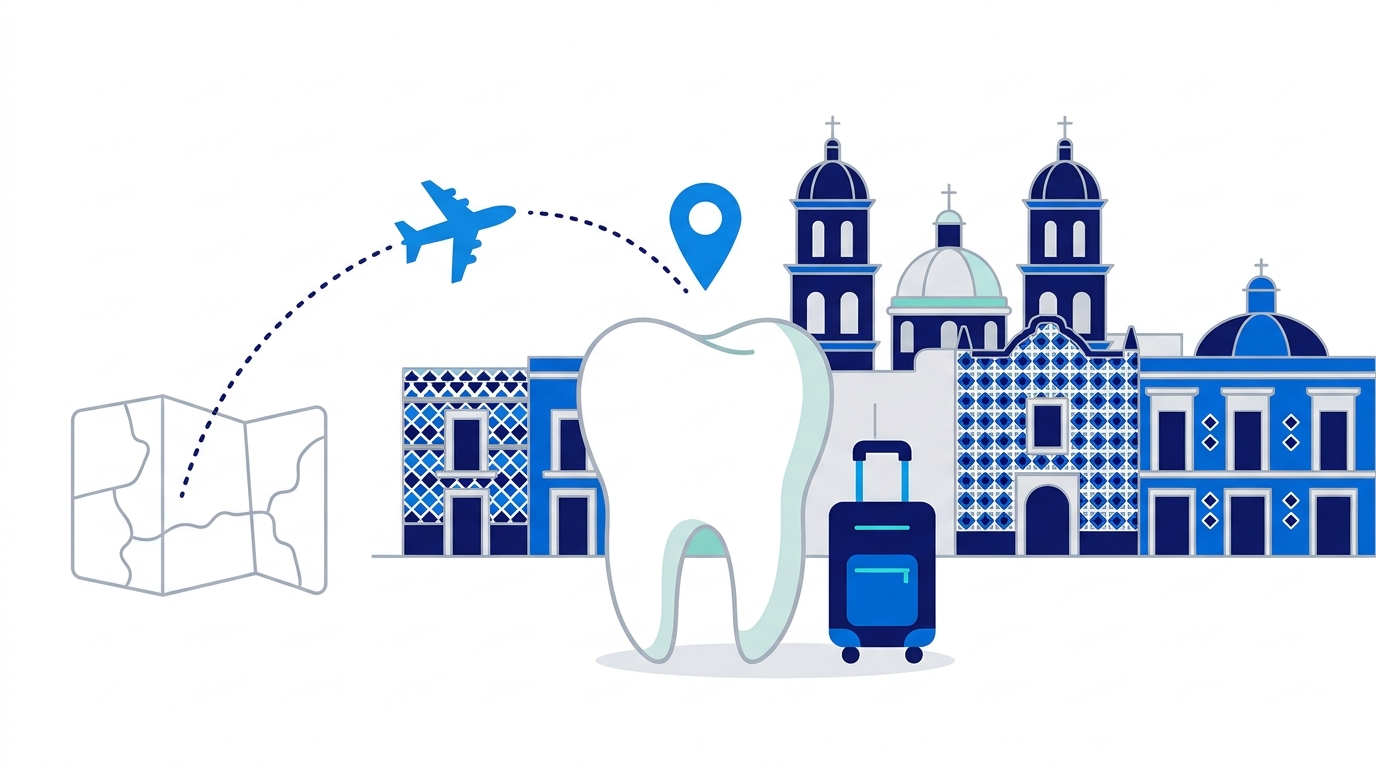
Dental tourism in Mexico means traveling there for dental work because it usually costs much less than in the US: Puebla dentists list a root canal between MXN 2,000 and MXN 3,500 (about US$110 to $190) on Doctoralia (the middle half of 98 listed prices, checked October 27, 2026), while a US cost study puts it at $679 to $1,733. Most Americans head for border towns such as Los Algodones and Tijuana, or for Cancún, which are the places they search for most. Puebla, in central Mexico, makes sense if you are flying anyway and your treatment fits in one or two trips; wherever you go, check the dentist’s license, get a written plan and price, and arrange follow-up care at home first.
Why do Americans go to Mexico for dental work?
Mostly cost and coverage. Original Medicare does not cover most dental care, including cleanings, fillings, extractions, dentures and implants (Medicare.gov). If you pay out of pocket, a trip can look worth it.
The best-known destinations are border towns. Los Algodones, about five miles west of downtown Yuma, Arizona, has around 600 dentists who serve American and Canadian visitors (Wikipedia). Tijuana and Cancún are the other places Americans search for most; Puebla rarely comes up. Others go to Costa Rica, Colombia or Turkey; the checklist below applies there too.
Is Puebla a good choice? When it makes sense and when it does not
There is no single «best city in Mexico for dental work.» It depends on where you live and how many trips you need.
Puebla can make sense if:
- You will fly anyway, so being close to the border matters less.
- Your treatment fits in one trip, or two trips months apart (veneers, crowns, a root canal, a single implant).
- You would like a large historic city between appointments: Puebla’s historic center has been a UNESCO World Heritage site since 1987 (Wikipedia).
- You have family in the area or speak Spanish (see our Spanish site). If you do not, that is fine: we speak English on WhatsApp and at the clinic.
Puebla is probably not your best option if:
- You live near the border and can drive: a clinic you can reach by car is easier to go back to.
- You need many visits. Braces take about two years on average, with regular visits for tightening (Cleveland Clinic).
- You cannot take several days off for each trip.
How dental work in Mexico works, step by step
- Get your records: recent x-rays and notes from your US dentist.
- Contact the clinic. Message us on WhatsApp in English or Spanish. Send photos or x-rays if you have them and we reply with a treatment plan and an estimate before you book your trip. The final price is confirmed at your evaluation in the clinic.
- See a doctor. The CDC suggests a visit at least 4 to 6 weeks before the trip (CDC).
- Evaluation in Puebla. The dentist examines you and confirms the plan and the price before treatment starts. Ask for both in writing.
- Treatment. Ask for copies of everything that was done.
- Follow-up at home with your US dentist, and a second trip if the plan has one.
How many trips does each treatment need?
This decides how many flights you buy:
| Treatment | How it is usually done | For your trips |
|---|---|---|
| Single dental implant | Surgery, then 3 to 9 months of healing before the abutment and crown (Cleveland Clinic). Ask how much time extractions or a bone graft would add. | Usually 2 trips, months apart. |
| Crown | Two appointments; the lab usually takes 2 to 3 weeks. Same-day crowns are not for everyone (Cleveland Clinic). | One stay of 2 to 3 weeks, or two trips. |
| Porcelain veneers | Two visits; the lab takes a few weeks (Cleveland Clinic). | One long stay, or two trips. |
| Composite veneers | No lab impressions needed (Cleveland Clinic). | Ask the clinic how many visits. |
| Root canal | One or two appointments, then a crown or filling (AAE). | Usually one trip; longer if the crown is made there. |
| Dentures | Several visits to get the fit right, plus adjustments in the first couple of weeks (Cleveland Clinic). | Stay for the first adjustments, or plan a return trip. |
Before flying, a 2023 British Dental Journal review recommends waiting about a week after most dental work, at least 72 hours after implant placement, a surgical extraction or a root canal, and at least two weeks after a sinus lift, ideally six (Felkai et al.). More on dental implants in Mexico.
How much does dental work in Mexico cost compared with the US?
US figures are national, from CareCredit’s cost studies. Puebla ranges are the middle half of prices Puebla dentists list on Doctoralia, checked October 27, 2026, at MXN 18.58 per dollar (Banco de México, October 26, 2026).
| Treatment | United States | Puebla dentists on Doctoralia | Clínica Dental Spota |
|---|---|---|---|
| Dental implant, implant only | $2,143 average, crown not included (CareCredit, 2024) | MXN 12,500 to 25,000 (about US$670 to $1,350), 36 prices; crown may not be included | Quoted at your evaluation |
| Root canal | $679 to $1,733 (average $978; CareCredit, 2026) | MXN 2,000 to 3,500 (about US$110 to $190), 98 prices | Quoted at your evaluation |
| Porcelain veneer, per tooth | $1,020 to $2,506 (CareCredit, 2026) | Median MXN 8,000 (about US$430), 11 clinics | From MXN 6,500 (about US$350) |
| Composite veneer, per tooth | $541 to $1,220 when made in the office (CareCredit, 2026) | Median MXN 3,000 (about US$160), 12 clinics | From MXN 2,500 (about US$135) |
| Cleaning | $203 average for an exam with cleaning and x-rays (CareCredit, 2023-2024) | MXN 500 to 800 (about US$25 to $45), 231 prices | Quoted at your evaluation |
What changes the price: number of teeth, material, extractions, bone grafts, x-rays or 3D scans, temporary teeth, lab work and number of trips.
What the comparison leaves out: flights, hotel, time off work and follow-up visits. The California Dental Association warns that the real cost includes travel, time and possible re-treatment at home, and that the expected savings «may be illusory» (CDA). See Mexico dental prices for crowns, dentures and more, and veneers in Mexico.
Is it safe to get dental work in Mexico?
It can be, but the checking is up to you. The US State Department says quality of care in Mexico «varies widely» and that your legal options in case of malpractice are very limited (State Department).
The CDC lists the main risks of care abroad: infections, including drug-resistant ones; counterfeit medicines or lower-quality devices in some countries; language misunderstandings; and follow-up care at home that can be costly and may not be covered (CDC). The ADA’s patient site adds that «the use of fresh gloves, sterile instruments and safe water is not standard practice in all countries» (MouthHealthy).
How to choose a dental clinic in Mexico: a checklist
- Check the license. Ask who will treat you and look up their professional license (cédula profesional) in the public SEP registry (cedulaprofesional.sep.gob.mx).
- Get a written, itemized plan: what each line covers (x-rays, temporary teeth, abutment, crown, lab), the currency, and what could change it.
- Ask about infection control. Gloves, masks, sterilized instruments and decontaminated surfaces are required in US dental offices (CDA). Ask how the clinic handles each.
- Ask what happens if there is a complication, whether it is fixed free of charge, and how follow-up works (CDA).
- Get the materials in writing (implant brand and model, veneer material) so a US dentist can work on them later.
- Ask which anesthetic will be used and how soon you can fly (CDA).
- Read reviews in more than one place.
- Take copies of your records home (CDC).
Getting to Puebla: airports, the bus from Mexico City, and safety
Passport: to fly to Mexico you need a passport book; a passport card is not accepted for air travel (State Department).
Flying into Puebla: Puebla’s international airport (PBC) is in Huejotzingo (Wikipedia). On October 27, 2026, Volaris was selling flights to Puebla from Houston, Los Angeles, Newark and Chicago (Volaris). Check that your flight is nonstop.
Flying into Mexico City: Puebla is about 131 km (81 miles) away by road, about 2 hours by car (Rome2Rio). Buses leave from the airport: it lists Estrella Roja for Puebla (AICM), and ADO also runs the route, with listed trips of about 2 hours 35 minutes to 3 and a half hours (Checkmybus). The clinic is in San Pedro Cholula, on the Cholula side of metro Puebla.
Is Puebla safe? On October 27, 2026, the State Department’s Mexico Travel Advisory (issued May 29, 2026) was at Level 2, «Exercise Increased Caution,» due to terrorism, crime and kidnapping, and says conditions vary from state to state. Nationwide, it strongly advises US citizens not to travel between cities after dark and to use dispatched taxis or apps like Uber or Cabify, not taxis hailed on the street (State Department). So plan your transfer to Puebla in daylight, and read the Puebla state entry before you book, because levels change.
Between appointments: the Great Pyramid of Cholula, the largest pyramid by volume known in the world, is in San Andrés Cholula (Wikipedia).
What to bring
- Recent x-rays and notes from your US dentist, and a list of your conditions and allergies.
- Your medicines in their original packaging, with a list of generic and brand names and doses (CDC).
- Travel health insurance that covers medical evacuation, as the CDC and the State Department recommend.
What happens if something goes wrong after you fly home?
The ADA’s patient site suggests arranging follow-up with a US dentist before you leave and confirming with your insurer that follow-up treatment is covered (MouthHealthy).
- Pain, swelling, bleeding or signs of infection: see a US dentist first; one who knows your history can catch problems early (MouthHealthy). Then tell the clinic that treated you, with photos and the findings.
- A crown or veneer comes loose, or an implant fails: agree beforehand, in writing, who pays and whether you must travel back.
- A dispute over the service: Mexico’s consumer agency, PROFECO, may be able to help (State Department).
Does insurance, Medicare or an HSA cover dental work in Mexico?
Medicare usually does not cover health care outside the US (Medicare.gov), and most hospitals in Mexico do not accept US insurance, including Medicare (State Department).
Dental plans: some pay part of out-of-network care abroad and some do not. Ask whether yours covers treatment outside the US, and re-dos at home (CDA).
HSA or FSA: IRS rules count dental treatment such as cleanings, x-rays, fillings, braces, extractions and dentures as medical care, but not teeth whitening (IRS Publication 502). Ask your plan administrator before you go and keep itemized receipts.
Frequently asked questions
Do you speak English?
Yes. You can write to us on WhatsApp in English, and we speak English with you at the clinic.
Who is the dentist?
Dr. Adriana Spota Aguirre, a dental surgeon (cirujano dentista) trained at BUAP, the public university of Puebla. Her Doctoralia profile lists her Mexican professional license (cédula profesional) as 4594335; you can check it in the SEP registry.
Is it safe to get dental work in Mexico?
It can be, but quality varies widely, according to the US State Department. Check the dentist’s license, get a written plan and price, ask about infection control, and arrange follow-up care at home before you go.
What is the best city in Mexico for dental work?
It depends on where you live and how many trips you need. If you can drive to the border, a border town is easier to return to. If you are flying anyway and need one or two trips, Puebla is an option.
How many trips do dental implants in Mexico take?
Usually two. The implant needs 3 to 9 months to heal before the crown is placed, according to Cleveland Clinic. Extractions or bone grafts can change the plan.
Are there Mexico dental tourism packages?
Some clinics and agencies sell packages with hotel and transfers. Compare the dental part on its own: ask for an itemized plan, and remember that any price before an exam is an estimate.
How far is Puebla from Mexico City?
About 131 km (81 miles) by road, about 2 hours by car. Buses from Mexico City airport take about 2 hours 35 minutes to 3 and a half hours.
Is Puebla safe for tourists?
On October 27, 2026, the State Department rated Mexico Level 2, «Exercise Increased Caution,» and says conditions vary by state, so read the Puebla state entry before you book. It advises not traveling between cities after dark and using dispatched taxis or apps like Uber.
Message us on WhatsApp in English or Spanish. Send photos or x-rays if you have them and we reply with a treatment plan and an estimate before you book your trip. The final price is confirmed at your evaluation in the clinic.
Updated October 27, 2026 · Reviewed against the sources below.
Sources: CDC, Medical Tourism · State Department, Mexico Travel Advisory · State Department, Mexico country information · ADA MouthHealthy, Travel · California Dental Association, Dental Tourism · Felkai et al., Br Dent J 2023 · Cleveland Clinic: implants, crowns, veneers, dentures, braces · AAE, root canal · CareCredit: average costs, implants, veneers · Doctoralia Puebla: implants, root canals, cleanings · Banco de México · Medicare.gov: dental, travel · IRS Publication 502 · SEP license registry · AICM buses · Checkmybus · Rome2Rio · Volaris · Wikipedia: Puebla airport, Los Algodones, Historic centre of Puebla, Great Pyramid of Cholula
Plan your visit
- Message us on WhatsApp in English or Spanish.
- Send photos or x-rays if you have them: we reply with a treatment plan and an estimate.
- Book your trip. The final price is confirmed at your evaluation in the clinic.
Clínica Dental Spota
Priv. de las Villas 3609, Fuentes de Saint Germaint, Santiago Momoxpan, 72776 San Pedro Cholula, Puebla, Mexico
Open in Google Maps
Phone: +52 222 703 2561
More for US patients