
Dental Spota » Dental Tourism in Mexico »
★★★★★ 4.7 on Google · 47 reviews
Dental Implants in Mexico: Cost and Process in Puebla
Real Puebla and US implant prices with their sources, how many trips to plan, and what to ask before you book.
Dr. Adriana Spota Aguirre · Dental surgeon (BUAP) · Mexican license (cédula) 4594335
- We speak English
- Estimate from your photos or x-rays before you travel
- San Pedro Cholula, Puebla, Mexico
A single dental implant in Puebla, Mexico, costs much less than in the US: Puebla dentists list between MXN 12,500 and MXN 25,000 (about US$670 to US$1,350) for an implant on Doctoralia (the middle half of 36 listed prices, checked October 27, 2026), while US cost guides put a complete implant with abutment and crown at about $3,000 to $6,000. Doctoralia does not say whether those Puebla prices include the crown, so compare full written quotes, not headline prices.
Plan on at least two trips, because the implant needs several months to bond with your jawbone before the final tooth is attached.
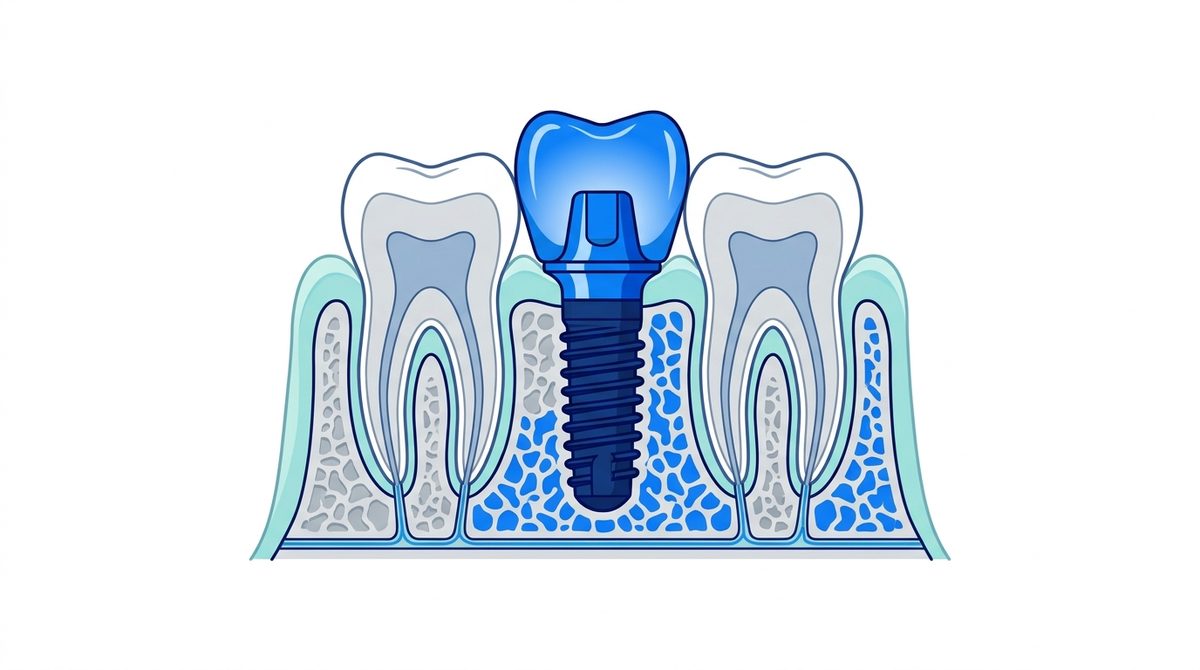
How much do dental implants cost in Mexico vs the US?
Pesos are converted at US$1 = MXN 18.58 (Banco de México FIX rate, October 26, 2026). The three US cost guides do not agree exactly, so the table shows each one.
| What you pay for | US price (source) | Puebla price (Doctoralia, checked October 27, 2026) |
|---|---|---|
| Implant post only | About $2,100 on average, $1,600 to $4,100 per tooth, crown not included (Humana, 2026). $2,143 average for a single full-size implant (CareCredit, 2023-2024 study). | MXN 12,500 to MXN 25,000 (about US$670 to US$1,350), middle half of 36 prices. Median MXN 18,500 (about US$1,000). Doctoralia does not say if the crown is included. |
| Abutment and crown | Abutment $500 to $1,000. Crown $800 to $3,000 (MetLife, 2025). | A few clinics list a crown on an implant separately, from MXN 8,000 (about US$430). No separate abutment prices listed. |
| Complete single implant (post, abutment and crown) | $3,000 to $6,000 (MetLife, 2025). $4,344 average for a standard implant, per tooth (CareCredit). | No complete price listed. See the worked example below. |
| Bone graft or sinus lift | Socket graft $558 average. Sinus lift $2,022. Graft using your own bone $2,779 (CareCredit). | No Doctoralia prices found. Quoted at the evaluation. |
| Full arch (All-on-4 or All-on-6) | $15,176 average for All-on-4 and $29,980 for All-on-6. The table does not say if this is per arch (CareCredit). | No full-arch prices listed. Implant-supported prostheses listed from MXN 7,500 and MXN 12,000 (about US$405 and US$650); Doctoralia does not say what they include. |
| Implant evaluation visit | Not compared | MXN 700 to MXN 1,300 (about US$40 to US$70), 5 listed prices |
A worked example. Take the upper end of the Puebla middle range (MXN 25,000) and add a crown at MXN 8,000: the total is MXN 33,000 (about US$1,780). That is about 40% less than the low end of the MetLife range ($3,000) and about 70% less than its high end ($6,000). It leaves out the abutment if billed separately, x-rays, any graft, and your travel.
Listed Puebla implant prices run from MXN 4,500 (about US$240) to MXN 60,000 (about US$3,230), and 21 of the 36 are «from» prices, so the final price is often higher.
What a Puebla implant price may leave out
- The abutment and the crown, if the price is for the implant post only
- X-rays or 3D imaging used to plan the implant
- Extractions, a bone graft or a sinus lift
- A temporary tooth while you heal
- The evaluation visit
Then add what no price list shows: flights and hotel for at least two trips, time off work, and follow-up visits with a dentist at home. Our Mexico dental prices page compares other treatments the same way.
How many trips do you need for dental implants in Mexico?
Most implants are done in stages, with months of healing in between. This is the usual sequence; your own plan is set at the evaluation.
| Stage | What usually happens | How long |
|---|---|---|
| Trip 1 | Evaluation, any extractions, and placing the implant. If the gap is visible, a temporary tooth can be made (Cleveland Clinic). | Most people feel normal within about a week (Cleveland Clinic). Wait at least 72 hours before flying (British Dental Journal, 2023). |
| Healing at home | The implant and the bone bond together (osseointegration). | 2 to 6 months (AAP). 3 to 9 months (Cleveland Clinic). |
| Trip 2 | Uncovering the implant if needed, attaching the abutment, then the crown. Some one-stage systems skip the uncovering step (AAP). | Gums heal for a couple of weeks after the uncovering step (AAP). |
| Extra time if you need a bone graft first | The graft heals before the implant goes in. | At least 3 months; large grafts 9 to 12 months (Cleveland Clinic). |
How many days you stay on trip 2 depends on how long the crown takes to make. Ask for that in writing before you book flights.
Full-mouth dental implants: implant-supported dentures, All-on-4 and All-on-6
If you are missing all or most of your teeth, implants can hold a full arch instead of single crowns. Cleveland Clinic says a full arch usually uses four to six implants. Implant-supported dentures (often searched as «denture implants») come in two types:
- Removable (snap-on) overdentures: the denture clips onto the implants, and you take it out daily to clean it.
- Fixed (hybrid) dentures: attached to the implants and removed only by a dentist for maintenance. All-on-4 is a fixed option that replaces a full arch on four implants (Cleveland Clinic).
All-on-4 vs All-on-6
The difference is the number of implants per arch. A 2023 study of 217 patients followed for 3 to 13 years found no significant overall difference in implant or prosthesis survival between the two. Six implants looked more predictable in some groups: older patients, people who grind their teeth, and people with low bone density.
Which full-mouth option fits your bone and budget is discussed at the evaluation visit.
Do you need a bone graft?
Implants need enough healthy jawbone. When bone has been lost, a graft can rebuild it, and Cleveland Clinic says grafts are commonly placed before implant surgery. The upper back jaw is the hardest area, because of thin bone and the nearby sinus. A sinus lift raises the sinus floor to make room for the implant (AAP).
A graft needs at least three months to heal, so it can add a trip. Ask whether you need one before comparing quotes.
Who is a good candidate for dental implants?
The American Academy of Periodontology (AAP) says you are an ideal candidate if you:
- are in good general and oral health,
- have enough bone in your jaw to support the implant, and
- have healthy gums, free of periodontal disease.
Cleveland Clinic says the minimum age is usually 18, with no upper limit. Smoking or vaping can disrupt healing. Untreated gum disease or unmanaged diabetes may make implants a poor fit until they are under control.
Dental implant risks, success rates and failure
Implants have a strong long-term record, but they are surgery, and some fail.
- Survival: A 2019 review of 18 studies found that 96.4% of implants were still in place after 10 years. When the authors accounted for patients lost to follow-up, the estimate fell to 93.2%, and to 91.5% for people 65 and older.
- Surgical complications: Cleveland Clinic lists infection, nerve damage, injury inside the mouth, and sinus perforation.
- Gum and bone disease around implants: A 2015 review found an average prevalence of 43% for peri-implant mucositis (gum inflammation) and 22% for peri-implantitis (inflammation with bone loss), with wide variation between studies. The AAP lists past gum disease, poor plaque control, smoking and diabetes as risk factors.
These are general research figures, not results from this clinic.
Flying home after implant surgery
A 2023 article in the British Dental Journal on dental tourism suggests waiting at least 72 hours after implant placement before you fly, and recommends about one week after most dental procedures. After a sinus lift the advice is longer: at least two weeks, and ideally six. The authors note that most of the research behind these numbers comes from military aircrew, so have your surgeon confirm your flight date.
What happens if a problem shows up after you fly home?
Cleveland Clinic advises calling your dentist if you notice:
- a loose or wobbly implant
- bleeding or swollen gums
- fever
- pus around the implant
- swollen lymph nodes in your neck, along with any of the above
Plan for this before treatment starts:
- Get your records before you leave. The CDC advises getting copies of all your records before you return home. For implants, ask for your x-rays and the brand, model and size of each implant, so a dentist at home knows exactly what was placed.
- Line up a dentist at home. The CDC warns that follow-up care for complications can be expensive and might not be covered by your insurance. The ADA notes that significant dental procedures need follow-up care.
- Ask in writing what happens if an implant fails: who pays for a replacement, and whether you would need another trip.
If something feels wrong, message the clinic and see a local dentist: some problems need an exam in person.
Is it safe to travel to Puebla for dental implants?
As of October 27, 2026, the US State Department’s Mexico Travel Advisory (dated May 29, 2026) rates Mexico at Level 2, «Exercise Increased Caution,» and says conditions vary by state, so read the Puebla state entry before you book. It advises US citizens not to travel between cities after dark, and to use dispatched taxis from regulated stands or apps such as Uber or Cabify instead of hailing taxis on the street. Plan any drive between cities, such as Mexico City to Puebla, for daylight.
The CDC advises seeing your doctor or a travel medicine clinician 4 to 6 weeks before the trip, checking the dentist’s qualifications, and getting travel health insurance that covers medical evacuation. For a full checklist on choosing a clinic and getting to Puebla, see our guide to dental tourism in Mexico.
Frequently asked questions
How much does a dental implant cost in Mexico?
In Puebla, dentists list between MXN 12,500 and MXN 25,000 (about US$670 to US$1,350) for an implant on Doctoralia (the middle half of 36 listed prices, checked October 27, 2026). The crown may be extra. In the US, MetLife puts a complete single implant at $3,000 to $6,000.
Does the Puebla implant price include the crown?
Often it is not clear. Doctoralia does not say whether listed implant prices include the abutment and crown, and a few clinics list a crown on an implant separately, from MXN 8,000 (about US$430). Ask for a written quote that lists each part.
How long do I need to stay in Mexico for dental implants?
Usually two trips. The first is for the evaluation and placing the implant; a 2023 British Dental Journal article suggests waiting at least 72 hours before flying, and about a week after most dental procedures. The second trip, after 2 to 6 months of healing, is for the abutment and crown.
Can I get same-day or immediate dental implants in Mexico?
Some full-arch treatments attach fixed teeth to the implants right after surgery, known as immediate loading, and a 2023 study followed patients treated this way for up to 13 years. Whether it suits you depends on your bone and bite, and is discussed at the evaluation. A single implant usually still needs months of healing before the final crown.
Are dental implants in Mexico safe?
Implant surgery has the same kinds of risks anywhere: infection, nerve damage and implant failure. A 2019 review found about 96% of implants still in place after 10 years. Check credentials (see how to choose a dental clinic in Mexico) and set up follow-up care at home before you go.
Does Medicare pay for dental implants?
Original Medicare does not help pay for dental implants. Some Medicare Advantage plans offer partial coverage, according to Humana. Ask your plan whether it pays anything for treatment outside the US.
How long do dental implants last?
With brushing, flossing and regular checkups, Cleveland Clinic says implants can often last a lifetime. The parts on top wear out sooner: crowns often last around 15 years, and an implant overdenture needs replacing every 15 to 20 years.
Message us on WhatsApp in English or Spanish. Send photos or x-rays if you have them and we reply with a treatment plan and an estimate before you book your trip. The final price is confirmed at your evaluation in the clinic.
Updated October 27, 2026 · Reviewed against the sources below.
Sources: Doctoralia, dental implant prices in Puebla · Banco de México, FIX exchange rate · MetLife, How much do dental implants cost (2025) · Humana, Does Medicare cover dental implants (updated 2026) · CareCredit, dental procedure costs (Synchrony 2023-2024 studies) · Cleveland Clinic, Dental implants · Cleveland Clinic, Implant-supported dentures · Cleveland Clinic, Dental bone graft · AAP, Dental implant procedures · AAP, Single tooth dental implants · AAP, Full mouth dental implants · AAP, Peri-implant diseases · Howe et al., 10-year implant survival, J Dent 2019 · Derks and Tomasi, peri-implant disease epidemiology, J Clin Periodontol 2015 · Zhang et al., 4- vs 6-implant full-arch prostheses, Clin Implant Dent Relat Res 2023 · Felkai et al., Dental tourism and barotrauma, Br Dent J 2023 · CDC, Medical tourism · ADA MouthHealthy, Travel · US State Department, Mexico Travel Advisory
Plan your visit
- Message us on WhatsApp in English or Spanish.
- Send photos or x-rays if you have them: we reply with a treatment plan and an estimate.
- Book your trip. The final price is confirmed at your evaluation in the clinic.
Clínica Dental Spota
Priv. de las Villas 3609, Fuentes de Saint Germaint, Santiago Momoxpan, 72776 San Pedro Cholula, Puebla, Mexico
Open in Google Maps
Phone: +52 222 703 2561
More for US patients